AI Writing is Teleported Steak
Why does everything I read taste synthetic?

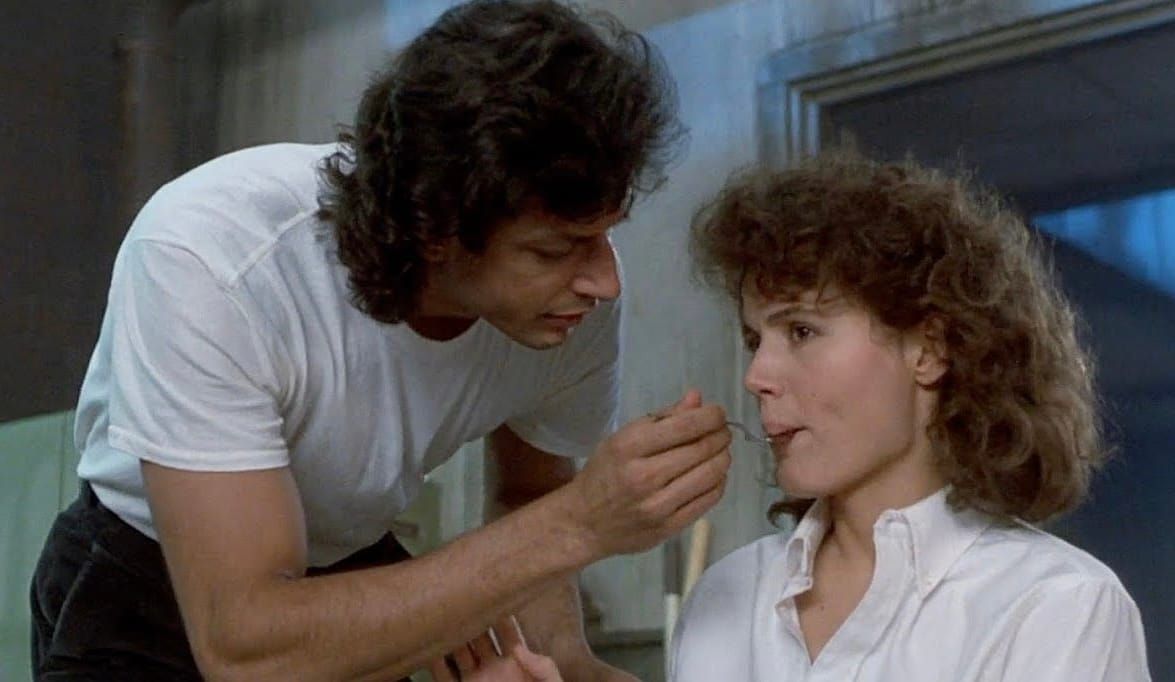
There’s a scene in David Cronenberg’s 1986 film The Fly that keeps coming back to me. Jeff Goldblum, playing the scientist Seth Brundle, wakes up in the middle of the night with his girlfriend Ronnie Quaife, played by Geena Davis, and has a sudden idea for an experiment. He cuts a steak in half, sends one half through the teleporter he’s recently invented, leaves the other as is, cooks them separately, and serves both to Ronnie for feedback.
Ronnie takes a bite of the unteleported half—yeah, could use some salt, but it’s steak. Then she bites into the teleported meat and immediately spits it out. It tastes synthetic. Brundle’s reply: “The computer is giving us its interpretation of a steak. It’s translating it for us, rethinking it, rather than reproducing it, and something is getting lost in the translation.”
This is basically what I feel when I encounter AI editorial, which is everywhere these days. I recognize that given my background and training, I may be more attuned to notice it than most. Yet I also see others having a similar reaction to AI rendered art, music and video (don’t get me started on music). I want to talk about the writing side because it’s what makes me want to spit out the synthetic steak.
There are real, identifiable reasons why AI writing can’t deliver what makes an author’s voice unique, or what makes good writing “good” (which in a broad sense will always be subjective).
To be clear, AI can be extremely useful for people who struggle with grammar, structure, or getting words onto the page at all. If it helps someone communicate who felt boxed in before, that’s worth something. But in terms of the qualities that make writing sing—AI cannot deliver those, and I’m honestly pretty happy about that.
As a matter of process, AI “training” takes the idiosyncratic and flattens it toward an average. These models have ingested millions of competent essays, and so they can replicate what they statistically believe that looks like, but they can’t capture voices that are outliers by nature.
Not that I’m such a unique voice, but everything I choose to do within a sentence comes from my relationship to syntax—how I feel the structure should reflect the meaning, aesthetically and architecturally, shaped by influences I’ve absorbed over decades. A machine doesn’t really have influences. It has predictions about what fulfills a request.
What allows writers and artists to be singular, even after absorbing other expression, is resistance from within and without. There’s organic hybridity being worked through. Emotion underneath. Memories and sensations intruding on the process, not all of them pleasant. The machine has none of that. Nothing shaping it the way pressure turns coal into a diamond.
Which gets back to the Seth Brundle conundrum (great band name). The teleporter reassembles all the correct molecules. The steak is chemically a steak. But the process that made it so isn’t part of the machine’s dialectic. It is only the model’s amalgamation of the perfect average steak. It is entirely lacking what Goldblum’s character called “the flesh.”
As Brundle says in the film: the flesh should make the computer crazy, like old ladies pinching babies. His solution is to teach the computer to be made crazy by the flesh, by the poetry of the steak. In the film, he can just go do that—ticky ticky tick. With AI, it’s not so easy, and I’ll leave it there for now.