Flying by Instruments
It’s not always easy, but it is possible.

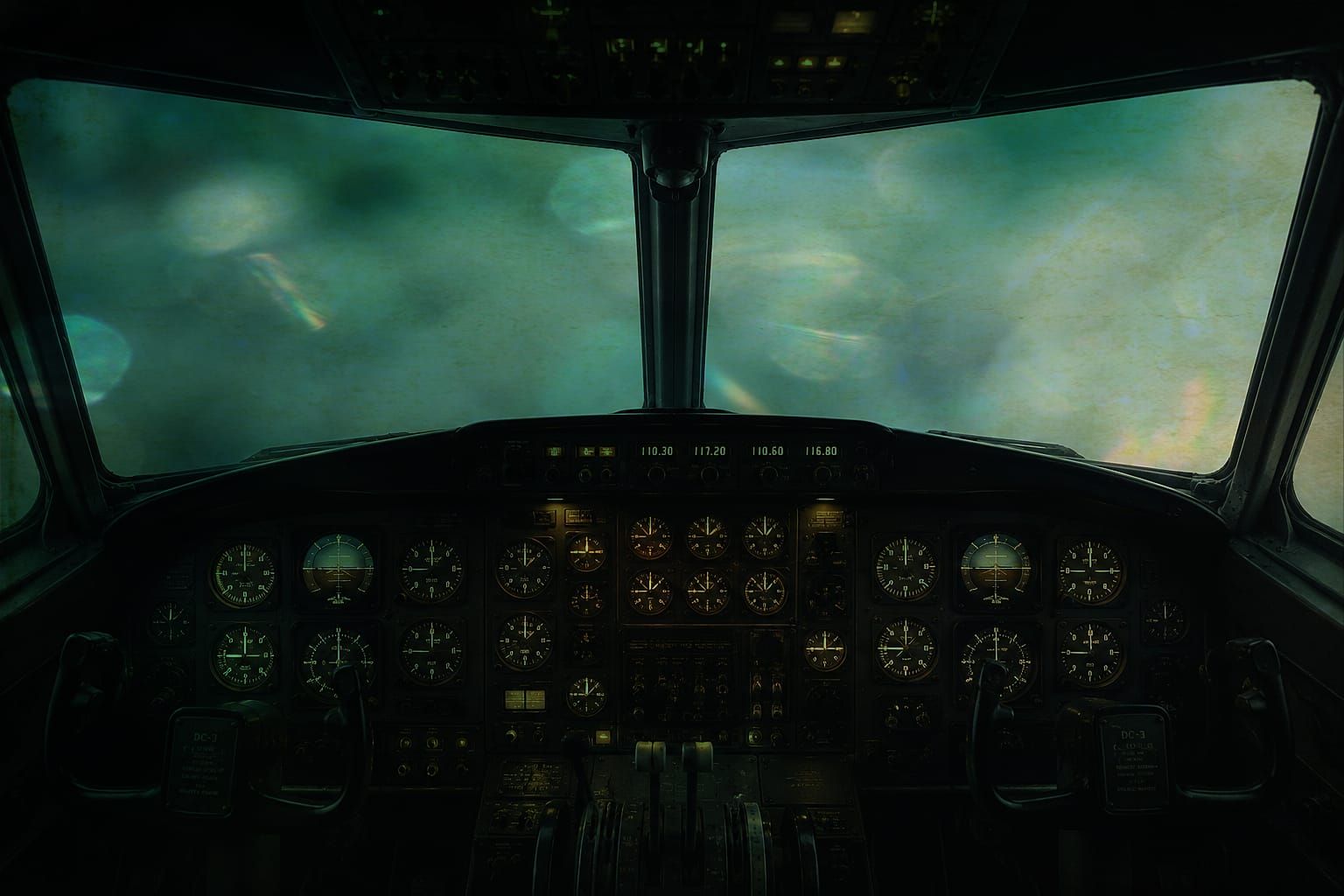
The last week knocked me on my proverbial, metaphysical, and actual butt. Bronchitis, most likely triggered—or at least significantly exacerbated—by local wildfires left me flattened. I’ve already written about the smoke, so I won’t revisit it here, except to say that the emotional charge of the experience nearly equaled the physical irritation. Together, they produced a period of destabilization that had me questioning who I even was.
If you’ve ever had a bad case of the flu or COVID with a high fever, you probably know the feeling. Brain fog, fatigue, and an inability to concentrate make ordinary life strangely unfamiliar. For the past little while, I’ve been flying by instruments, occasionally checking in with my wife to ask basic questions like, “Is this forever?”
All in all, it has been good practice. A chance to work with my mind, a small rehearsal for death, and a reminder of how quickly situations can change. Whatever form we become accustomed to inhabiting eventually reveals itself to be far less dependable than we imagined.
So what is dependable?
The unfolding of experience. Every felt sense has a reason, is mutually conditioned, without intrinsic existence, and passing. Circumstances arise through a multitude of causal factors far beyond the mind’s ability to account for. Eventually they exhaust the conditions that sustain them and return to the same basic ground from which they never truly strayed. Of course, knowledge of this only gets you so far. Sometimes you just have to feel your way through.
The difficult part is allowing the above to reveal itself by doing as little as possible. Physical and emotional discomfort ignite every impulse to fix, solve, escape, or control. The more grasping and rumination take hold, the harder it becomes to witness a process that is already moving toward release, one way or another.
Too, the recognition of impermanence is something of a double-edged sword. In a relaxed, non-grasping mind, transience reveals itself as equanimity within diversity, inseparable from the ground of awareness. But when things get all balled up at the head office, it feels less like ease and more like death by a million paper cuts.
I’ve been experiencing the latter in completely ordinary ways. I still have the impulse to save time in a bottle whenever I look at my family. Watching my children grow is beautiful, but it also comes with the suffering of change. One kid who was recently little is no longer so. The other is somehow a young adult. Add to that the reminder, delivered by illness, that my own body is subject to sickness, aging, and death, and this wisdom becomes much more immediate.
One unexpected consequence of being sick was realizing how few of my usual interests were available under distress. I couldn’t study or compose. Translating Tibetan was out of the question. Jazz guitar required more concentration than I could manage. Dharma practice remained available, of course, but sometimes simply enduring physical and emotional discomfort calls for benevolent distraction. For me, that turned out to be Tales from the Crypt, of all things.
I’d only seen scattered episodes growing up. We weren’t an HBO family, and by the time the series was in full swing I was already out on my own and certainly couldn’t afford cable. What I never realized was its astonishing pedigree. The series was produced by Richard Donner, Walter Hill, David Giler, Joel Silver, and Robert Zemeckis—all heroes of horror and comedy. The guest stars and directors are a who’s who of twentieth-century film and television.
What struck me most, though, wasn’t the surprising quality of the show. It was how many of the people appearing in it are no longer with us. That’s probably an appropriate realization for a series hosted by a wisecracking skeleton named the Crypt Keeper.
Alas, I’m beginning to feel more like myself again, so the spooky puppet can go back in the box. As for me, I’m planning to stay above ground. For now, anyway.