Last Call, First Listen
The hauntingly serene film Last and First Men phones home from two billion years into the future. Don’t let it go to voicemail.

I don’t usually talk films on a Monday—that’s Friday territory, and even then I tend toward the lurid end of the spectrum. But my dear friend Joe sent me a copy of Last and First Men (2020), and anything he recommends is worth a look. This one fit the Monday vibe after all.
By the time the film came together in 2017, director Jóhann Jóhannsson was better known as a composer, having scored Denis Villeneuve’s Prisoners, Sicario, and Arrival, James Marsh’s The Theory of Everything, and Panos Cosmatos’s Mandy, which is where I first heard him. Last and First Men was his directorial debut, and the only time the composer wore the helm. Jóhannsson died of an overdose in February 2018 with the film unfinished; Yair Elazar Glotman completed the score, Sturla Brandth Grøvlen the visuals. When it arrived two years later, it was a transmission from a man already gone, carried forward by the living—an uncanny echo for a film whose themes explore evolutionary persistence and impermanence.
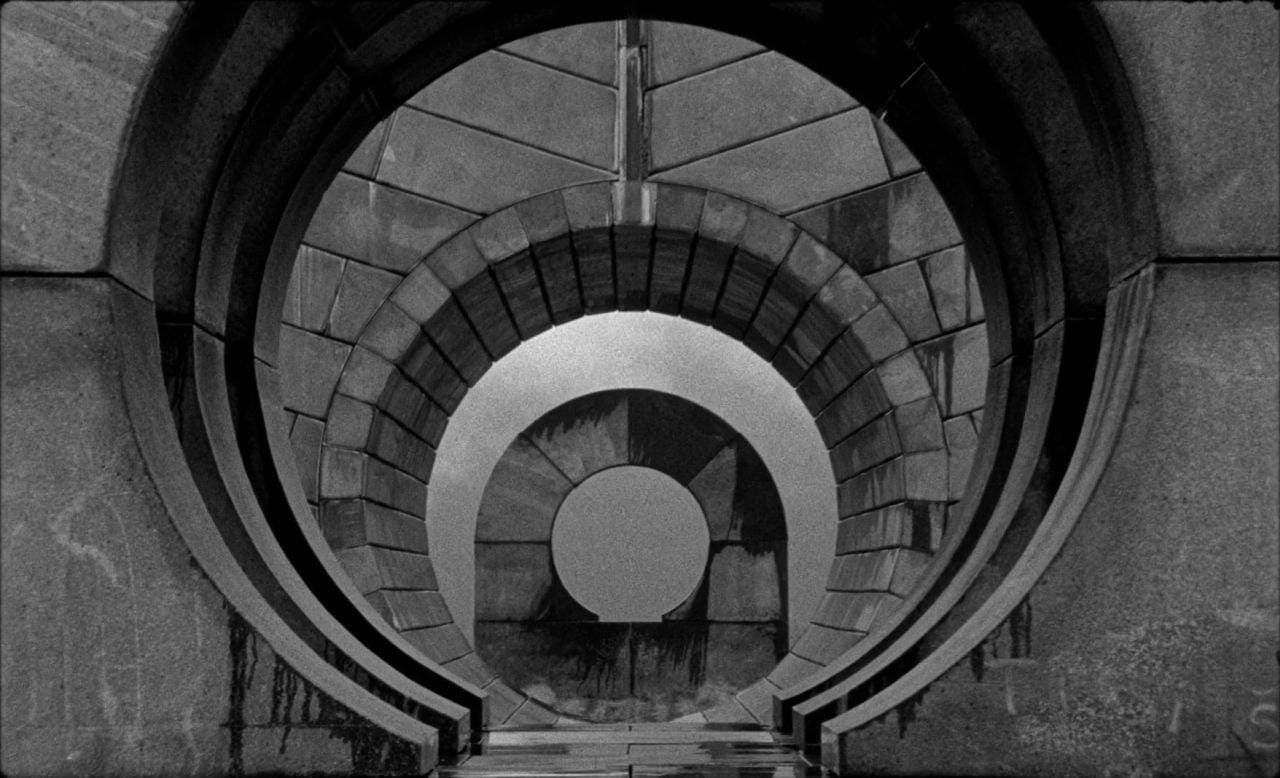
Tilda Swinton narrates with glacial pauses as a representative of the Eighteenth Men—humanity’s final form—broadcasting across two billion years to us, the original model. “Listen patiently,” she intones as the camera surveys alien-looking Yugoslav war memorials shot in grainy black-and-white 16mm—brutalist concrete shapes that seem hewn from non-human sources. “The stars have their beginnings and their ends. For a few moments, somewhere in between, a few, very few, may support thought.”
The Eighteenth Men have long since fled a ruined Earth for Neptune, but the sun is dying faster than they can outrun it. Millennia of benevolent, self-guided evolution has granted the species incredible gifts: organic networked telepathy, quasi-immortality, and interstellar travel through a kind of light body emanation. Yet even their power to literally move worlds doesn’t forestall their extinction. So they expend their remaining energy on a transmission backward through time: part warning, part plea for remembrance in a sanguine acceptance of their fate within the cosmic play of appearances.
The film takes its name and overall gist from Olaf Stapledon’s 1930 novel, a “future history” that tracks eighteen human species across brief accelerations and inevitable backslides into desperation and bloodshed. Though it sold modestly, Last and First Men shaped pretty much everything that followed. Arthur C. Clarke said Stapledon’s book influenced him above all; other admirers include Stanisław Lem, Brian Aldiss, and C.S. Lewis. The novel’s narrative, philosophical, and thematic imprints are readily observed in Frank Herbert’s Dune, Isaac Asimov’s Foundation, and Clarke’s 2001: A Space Odyssey. It’s as though Stapledon was himself a First Man transmitting forward, seeding ideas that wouldn’t germinate until meeting the minds of writers who could reap their fruit. A kind of sci-fi terma* for the 20th century and beyond.
What these Last Men describe of themselves is curiously dharmic. A third eye atop the skull, through which their astronomers read the cosmos. An omniscient view into their ancestors’ lived experience as unified mind. Lifespans of unthinkable length. They seem like the devas of the “god realm,” sublimely secure and drunk on near-immortality. But the thing about the god realm is that it always comes to an end.
“Great are the stars,” Swinton says, “and humankind is of no account to them.” The Eighteenth Men are not exempt from impermanence. They have only postponed it long enough to see the symmetry of their star-engendered birth and demise. Their end captures the particular sorrow of the devas—their vast lifespans end, and the ending, when it comes, is more painful for having been deferred.
The essence of their message: we are both unfinished and temporary. The First Men are not a rough draft of the Last Men; the Last Men can never be the definitive outcome. There is no final form at the end of the evolutionary corridor, no terminal species that gets to step off the wheel. There is only the next form, doing what the prior form did, which is to transform until its supports are mutually exhausted.
Jóhannsson’s Last and First Men depicts the final testament of a species doomed from the outset, yet awed by a timeless cosmos that enabled and encompassed their struggles and triumphs while remaining unstained by any of it. The film itself is a monument outliving its maker, as unhurried and contemplative as the source material.
Listen patiently. The transmission is addressed to us.
*Terma (Tibetan: “hidden treasure”) are concealed teachings to be revealed when they’re most needed, often recovered across centuries by a tertön, or “treasure-revealer,” when conditions ripen.