Mind Out of Time, Time Out of Mind
Some say we should live in the present, but try to pin it down and it vanishes. So do ideas about past and future. Might as well take that long lunch break.

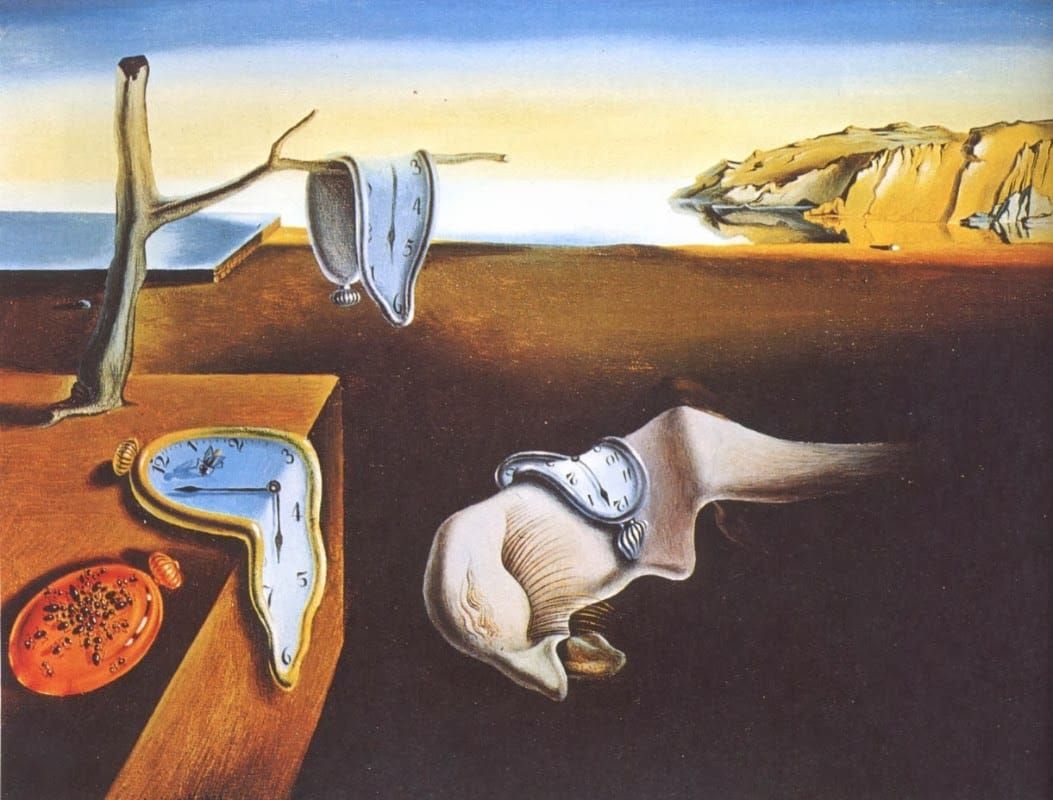
Time keeps on slipping into the future. Sometimes that feels fast; other times it can seem interminable. An hour spent doing your taxes—or thinking about doing your taxes, or thinking about avoiding doing your taxes, or attempting to avoid thinking about doing your taxes—will feel like an eternity. Whereas something more enjoyable, which could be just about anything, tends to go by in a flash. As human beings, our perceptible sense of chronological, measured time is all over the map.
We spend a good deal of our waking lives in what I’ll call Conceptual Projected Time: thought loops about the past, about the future, and wtf is going on at the moment. Yes, you might say, but don’t all you Buddhist types rail on about the present? “Be here now” is one of the slogans you might hear, an old one coined by Ram Dass back in 1971. But the thing about the present is that you can’t really “be here now” conceptually.
Besides, the present isn’t one thing. Whose present are we talking about? Mine? Yours? A butterfly’s? All of them? If it’s all of them, that’s hard to even imagine. And the moment we try to name a single thing within this undefinable present, the picture has already shifted, right down to the positioning of the elementary particles comprising the atoms in your body. Everything is constantly changing, mutually influencing everything else. So where is this present? Nowhere I can find. Which means maybe there’s no need to fuss so much about it.
The past is a bigger one. We spend a lot of time there, particularly as we get older—turning over things we might have done differently, paths we attempted but somehow didn’t complete, options that now seem foreclosed. Even a child can get stuck on something that happened earlier in the day. It’s a human thing. And yet we can’t actually inhabit the past or reconstruct it in any real way, because much like the ever-changing present, the specific arrangement of aspects that existed then have already been transformed or exhausted. There is no DeLorean, no 88 miles per hour, no 1.21 gigawatts to get us back.
Nor can we travel to the other conceptual time we spend so much energy perseverating over: the future. Despite our constant strategizing, the future isn’t something we can establish; any thought we have about it is taking place now. It arrives on all its own, but then it’s no longer the future. Should we prepare for outcomes using our sense of what’s useful or necessary, what we’ve observed from cause and effect? Absolutely. But that is different from ruminating about what is or isn’t going to happen—which, even with every preparation, we wouldn’t ultimately control.
What Buddhists call “the three times”—past, present, and future—are sometimes useful yardsticks. But they are conceptual designations that can also keep us stuck and distracted, thereby missing out on the rich experience of basic aliveness.
You can’t fashion the three times into anything solid, and even if you could, they wouldn’t remain. Past collapses into present, present collapses into future; ideas about all of it collapse into space. You can’t grasp them at any end. And so, from time to time, it’s nice to simply stop trying to.
There’s something almost paradoxical about working all of this through conceptually—trying to think your way out of thinking. But the point isn’t to replace one set of concepts with a better one. It’s to set them all down: the ideas about past, present, and future, individually, collectively, metaphorically, literally. And simply experience what’s present in the entirety of your knowing—all of which, like everything else, will prove to be temporary.
Just for a minute. Try it on your lunch break. While you’re brushing your teeth. Sure, on a meditation cushion, if you have one. And by “try it,” I mean don’t do anything at all. Simply let go of all these concepts and rest for some “time.” Then go about your business.