Ordinary Refuge
Small moments can remind us that the world is more than what we’ve learned to fear.

The other day, I was taking a nice walk with a friend in nature when someone snapped this picture of me:
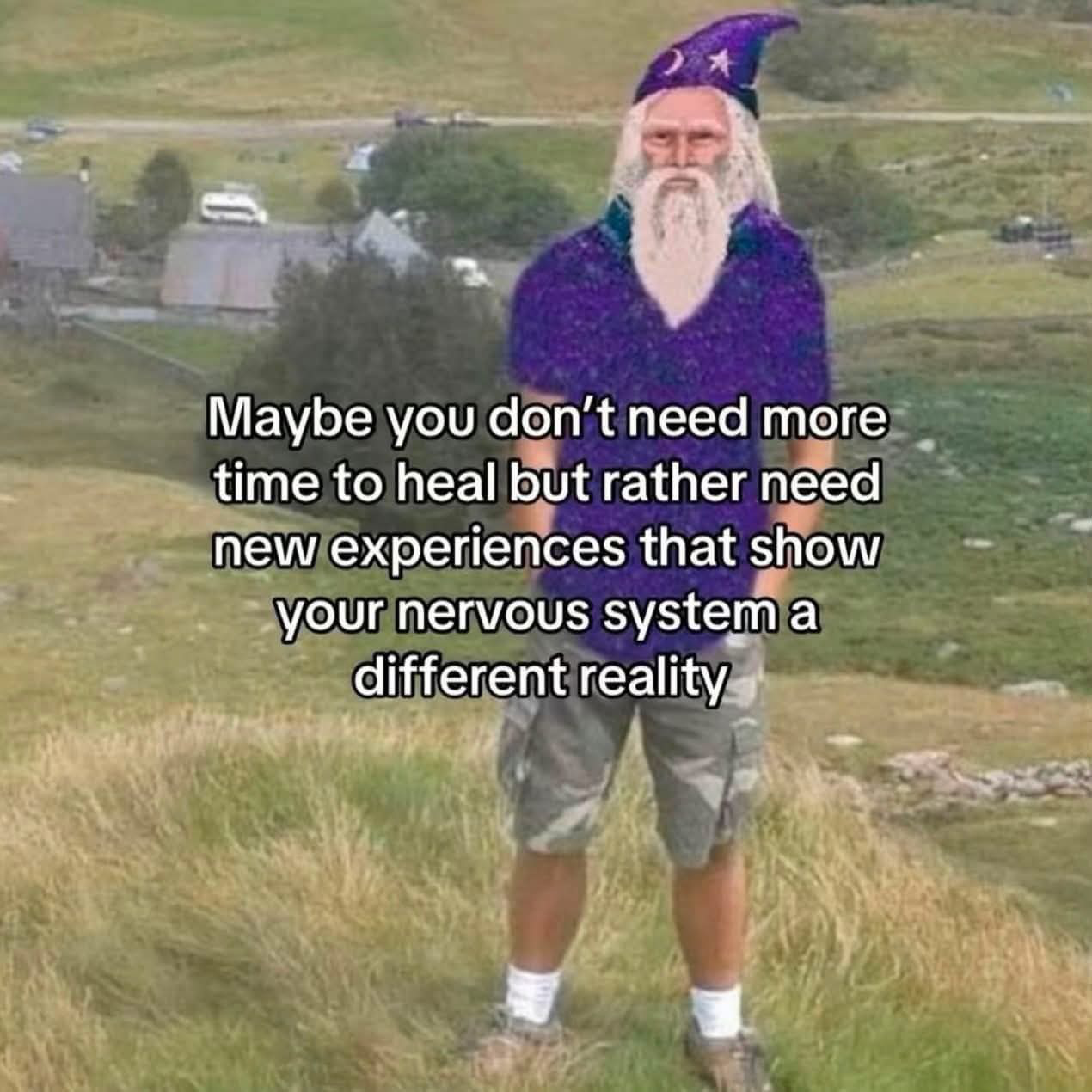
Bargain-basement wizard aesthetic aside, it’s a nice idea: maybe healing isn’t simply a matter of more time, deeper analysis or constantly returning to the injury.
Time is obviously necessary for many kinds of repair, but by itself, I’m not sure it’s the panacea we sometimes imagine. After all, we can spend 20 years reexperiencing a wound or rehearsing the same fears. (And doesn’t the therapeutic industrial complex love that?)
Unfortunately, there isn’t a single perfect way to heal (sorry, self-help gurus). But one thing that aids the process is inviting experiences that differ from what we’ve come to anticipate.
Trauma, in particular, conditions expectations. Without getting overly clinical, the nervous system learns from experience. If certain situations repeatedly meant danger, abandonment, humiliation or unpredictability, more of the same can begin to feel inevitable. This can persist long after the original circumstances have changed. You probably already knew that. The body keeps the score, blarbity-blarb.
But if that’s true, it also means we can learn more. Not necessarily intellectually, but experientially.
This begins with noticing and permitting. We can accumulate new experiences or reacquaint ourselves with familiar ones—perhaps small or unassuming—that aren’t destabilizing or traumatic. It doesn’t have to be one enormous corrective. Often, simply opening to the mundane aspects of being a person in the world allows us to recognize what else is available.
Yes, there’s a “spiritual” dimension to this. Refuge is central to Buddhism, though the concept can sometimes sound more monolithic or doctrinal than it needs to. At heart, refuge is also a very ordinary human activity: finding somewhere, someone or something in which we can rest, even for a little while.
Refuge isn’t necessarily escape. It doesn’t mean constructing a world where difficult things can’t touch us. Good luck with that. Instead, we can reacquaint ourselves with experiences within this world that don’t confirm our habitual expectations of it being a shitshow. Though it may indeed be a shitshow—temporarily, anyway. Yes, “temporary” can still feel like a long time, but the shitshow is never the whole story.
This is why the ordinary stuff is a good place to start. A comfortable chair you love. The familiar presence of your partner or a pet. A friend who answers the phone. Walking somewhere you like. Putting on a favorite record. Making a cup of tea. Practices that relax the mind and body.
These things can seem trivial because they’re not particularly dramatic or intense, and that’s the point. Experiences we perceive as negative tend to imprint themselves more readily than pleasant or neutral ones. That bias probably serves some protective function. But if we remain within the cognitive space of needing to solve, reject or escape something even when danger isn’t present, we don’t experience the basic comforts of what’s reliable right here and now.
Ordinary refuge is accumulating small bits of evidence that safety can happen, pleasure can happen, boredom can happen. Your body can settle. Your mind can simply experience what’s present without adding or taking anything away.
It’s not about trying to construct safety as some ultimate goal. Impermanence makes that impossible. Refuge doesn’t guarantee that nothing will be lost or transformed. Instead, it can change our relationship to uncertainty. A sense of trust—not in particular outcomes, but in our capacity to meet what occurs—can gradually emerge through familiarization with these small turnings toward what is already here.
We often imagine transformation happening through breakthroughs, revelations, therapeutic interventions, spiritual retreats, initiations or peak experiences. Sure, watersheds occur. But much of what changes us is pretty basic. We are processes, after all, and change is already underway. We don’t have to chase it.
Sometimes it’s enough to appreciate a good meal, a conversation, a nice walk, an uneventful afternoon. This might mean stepping away from what continually provokes us instead of poking the bear. Still, refuge is less about locating a protected place outside experience than rediscovering something hospitable within ourselves.
The wizard aesthetic is strictly optional.