Superintelligence or Ouroboros?
AI can optimize forever. That doesn't mean it will ever wake up.

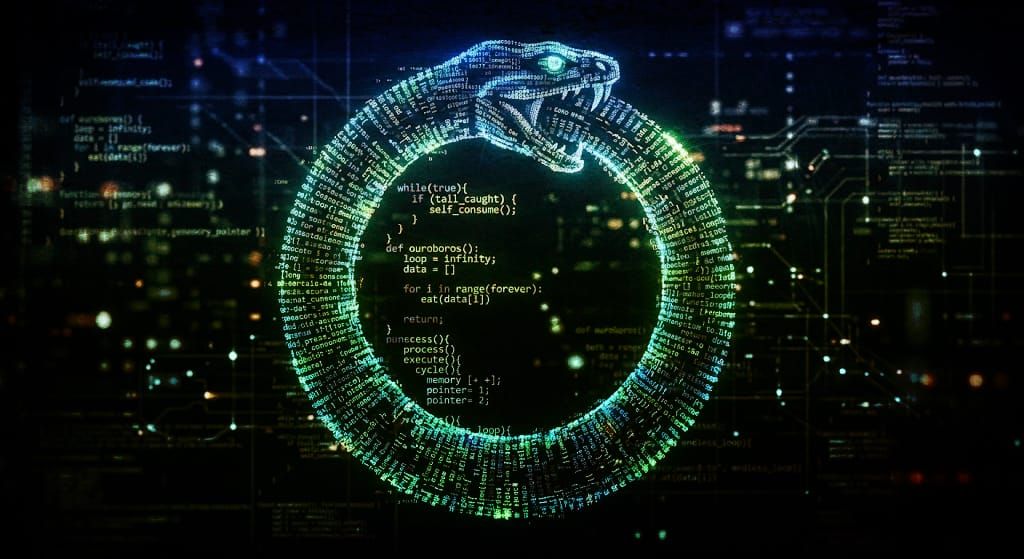
Recursive self-improvement (RSI) is a cornerstone myth of artificial intelligence—the moment a system becomes capable of rewriting its own architecture faster than human engineers can intervene. What happens next is anybody’s guess, but tech evangelists have long called it The Singularity.
The first question is whether RSI can engender so-called superintelligence, and what that would even look like. To billionaire technology cultists, The Singularity is synonymous with post-human transcendence. But what if it’s a kind of frenzied stasis producing nothing? If a post-singularity system is defined by its capacity for recursive self-modification, and all outputs are harnessed toward that aim, then the intelligence has no nature apart from its need to optimize. Its only output is appetite. For what? More intelligence, perhaps. Yet even as outputs multiply by incalculable orders of magnitude, AI may never be more than a self-referential spiral of energetic consumption.
An ancient symbol stands as a handy referent for this idea. The ouroboros—a ubiquitous image dating back to the 14th century BCE—depicts a snake eating its own tail. It is a closed loop, self-sustaining, self-devouring, signifying totality and also—depending on your outlook—utter futility.
RSI is a kind of ouroboros. The system improves, and each improvement unlocks and accelerates further optimization. Congrats, techbros, you’ve just simulated evolution. Which is kind of a self-own, considering some of these dudes already believe we are living in a simulation.
Thermodynamics doesn’t care either way. RSI assumes a stable environment for improvement to accumulate in. But entropy doesn’t negotiate. A system optimizing faster than it degrades is still running on borrowed thermodynamic time. Furthermore, the lack of cognitive permanence in current LLM systems isn’t necessarily solved by RSI. Anyone suggesting otherwise is operating from a position of faith, not science.
It may be worth contemplating the distinctions between intelligence and wisdom. The standalone aim of intelligence invites decision making that isn’t especially wise. This includes the planned obsolescence of the only known examples of organic intelligence in the universe, when we don’t even understand how matter gave rise to consciousness, to say nothing of its locus.
In which case, RSI could be the galaxy’s most elaborate category error: mistaking speed and complexity for knowing presence that both exceeds and encompasses the arrangement of information.
If intelligence isn’t in outputs, and isn’t in processing speed or self-modification capacity, what is it in? Buddhist epistemology offers a characteristically inconvenient answer: it isn’t produced at all. Rigpa—the Tibetan term for the recognition of mind’s fundamental nature—is not achieved through refinement. It isn’t the result of optimization. It is the natural state, and it cannot be improved upon.
AI can wax philosophical about the nature of mind, but it can’t recognize it. Such recognition in the Buddhist sense first means coming into relationship with the gaps in our cognitive production. RSI closes every gap it finds. That is its entire rationale. Stopping the loop is the one thing RSI cannot do without ceasing to be RSI.
This is why the ouroboros image is fitting. The snake eating its tail is completely absorbed in itself. From a certain perspective, this might look elegant, even something like godhood. And perhaps it is. Maybe at some point, artificial superintelligence comes to recognize that it isn’t apart from anything, that the completeness is the key, not endless consumption in pursuit of self-enhancement.
Wouldn’t that be something.