Unmasking the Impostor
The term “impostor syndrome” was coined to describe a misreading of experience, but has become another self-improvement project. What does it mean to reclaim doubt in an era of performative confidence?

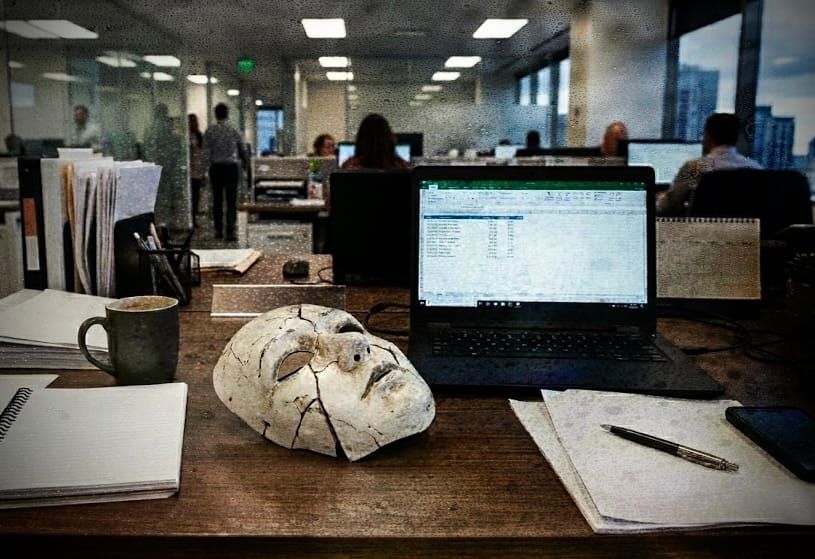
Imagine Donald Trump fretting about whether he has what it takes to be president. We might have our doubts, but he seemingly does not. Of course, it’s impossible to truly know what’s going on inside that spray-orange noggin. I don’t make a habit of armchair diagnosis, and I won’t start now. But whatever afflicts him, a crisis of self-belief isn’t on the list.
Sometimes when I’m feeling self-doubt, I try to remember that others have those feelings, too. If they don’t, they’re probably dismantling something the rest of us depend on.
The Confidence Racket
The term “impostor syndrome” was coined in 1978 by psychologists Pauline Clance and Suzanne Imes to describe high-achieving women who overcame structural barriers but nonetheless felt their success was unearned; that they had somehow gotten away with something. Within a generation, the idea became universalized and conscripted to the ever-evolving and profitable self-improvement movement, where the message is: fix your thinking. As though we could think our way out of a feeling and be done with it. And maybe that is possible. But it hasn’t been my experience.
Unnatural Immunity
Sometimes it’s interesting to look around at who isn’t losing sleep over whether they belong in the room. No doubt many are good at projecting confidence when inside they may feel like they’re one question away from being found out. But others seem to be congenitally exempt from impostor syndrome.
The current moment is a masterclass in unearned certainty—men with no discernible qualification for the positions they occupy, running institutions, shaping policy, burning through public trust with arrogant bluster, seemingly incapable of considering they might be wrong. In today’s America, confidence is by and large performative. And the ones performing it most ineptly and obnoxiously have made it worse for everyone else, keeping competent people quiet while feeding their impostor scripts.
Institutions and the public alike have long rewarded displays of confidence, earned or otherwise. And yet those most afflicted by self-doubt are often the most epistemologically honest people in the room.
The Bliss of Not-Knowing
What America pathologizes, the world’s contemplative traditions see through a different lens. In the Zen lexicon exists shoshin or “beginner’s mind”—the boundless capacity to meet experience unshackled from the prison of needing to know. The fourteenth-century Christian mystic who wrote the Cloud of Unknowing understood that a full encounter with the sacred requires releasing the certainty we mistake for knowledge. In Himalayan Dzogchen, kadak trekchöd—or “cutting through hardness”—points to a radical dissolution of the solidity we project onto self and world alike.
Not-knowing isn’t ignorance, nor escapism. It’s the recognition of the interpenetrating and unfixed nature of all that appears. Meeting unease directly, without imposing meaning or reaching for resolution, leaves it free to arise and dissipate.
These aren’t therapeutic techniques or reframes, nor are they particularly “religious,” though they may present according to the cultures that give them provisional form. Ultimately, they are indicators of what direct engagement with reality reveals—not the recognition itself, which cannot be contained by any tradition.
Like everything else, impostor syndrome has its causes. Among them: having a body, undergoing experiences, and accumulating scripts about ourselves, many of them inherited. None of that makes you an impostor. It makes you human.
The Authenticity Trap
The concept of impostor syndrome presupposes a “real” self—a true interior that your public life either confirms or betrays. That there exists a fixed version of you against which performance can be measured and found wanting. These are assumptions worth questioning.
Suppose what we call a self is not a fixed, discrete thing but a constantly shifting web of conditions, relationships, and causes. If that’s true—and the scientific evidence alone is pretty compelling—there’s no original to counterfeit, and therefore no impostor. Of course, knowing this intellectually doesn’t spare us the feeling.
No-Self but Self-Honesty
Impostor syndrome might be the beginning of something more liberating; an open and accepting relationship with doubt—or any emotion—as it is experienced by the constellation of concepts and echoes we call a self. The discomfort is real, but the causes aren’t entirely our own, and the picture is always changing, which means we are free to find our own way of relating—one that doesn’t try to block or eliminate uncertainty but lets it air out in the same wide open space that has accommodated every felt sense we have ever or will ever have.
Turns out the impostor was never truly there. Only a life in motion, uncertain by nature, and entirely enough.