Viewing In-Between: Films That Refuse to Be One Thing

Last week, I talked about “blended genre” flicks, with a promise to take a closer look the following Friday. Well, here we are—Friday the 13th, which also happens to be Dakini Day.* Fitting, given what I’ve come to realize about the films on this list, and their uncanny ability to discombobulate and illuminate.
I love movies that can’t decide what they are. Or more precisely, movies that have decided to be several things at once and don’t apologize for it. Sunset Boulevard is the ur-text: a noir, a melodrama, a Hollywood satire, a ghost story, narrated by a dead man floating in a swimming pool. More recently, Bugonia saw director Yorgos Lanthimos wrapping dystopian satire inside psychological horror inside absurdist sci-fi. And now The Bride!, Maggie Gyllenhaal’s unruly Frankenstein riff, lands in theaters and is confounding everyone who sees it in part because it refuses to be one thing.
These movies share more than thematic promiscuity. They’re all bardo** flicks, set in between-states, precarious thresholds, stretches of interminable stasis giving way to transformations that may or may not resolve. Shit will get weird, sometimes even scary. But we can still have fun.
Here are some of my favorite mixed genre flicks for your consideration. Ask me again later, and you might get an entirely different list.
Sunset Boulevard (1950) — My favorite movie of all time, and the one that sets the terms for everything that follows. Writer-director Billy Wilder and his co-scribes Charles Brackett and D.M. Marshman Jr. fuse noir, melodrama, Hollywood satire, and gothic horror so completely that you can’t extract one from the others. The trick is that Joe Gillis is already gone when he starts talking—the entire film is a bardo narration, a dead man’s account of how he got that way, delivered from the swimming pool where we first find him floating. It’s a small cast and tight focus, which is typical for Wilder. What’s unusual is the sumptuousness with which he renders the decaying Hollywood mansion. And Norma Desmond, my stars. I watch this movie at least once a year, and every time it feels fresh, despite the cobwebs and mothballs.
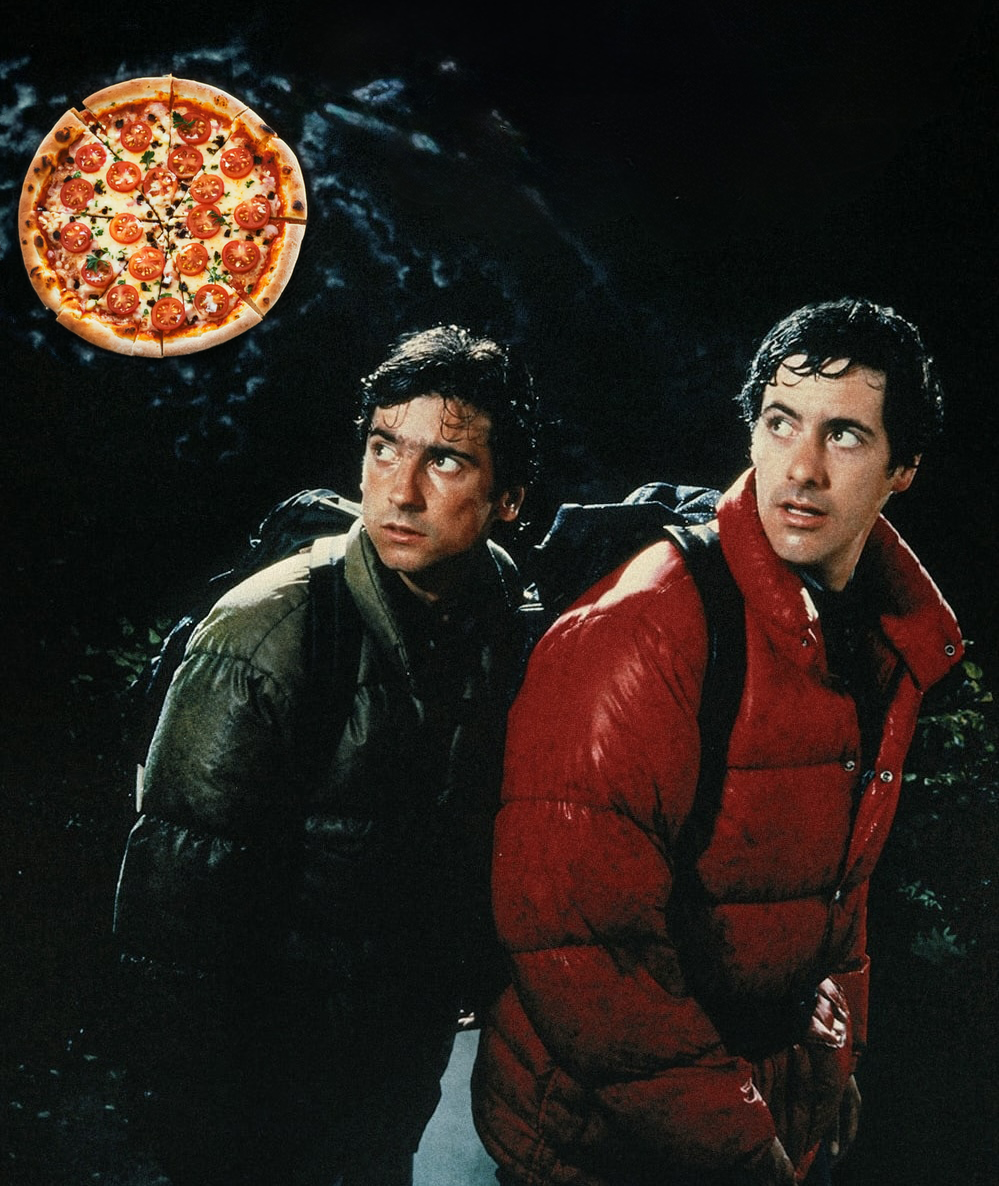
An American Werewolf in London (1981) — My number one in the horror-comedy category, and the gold standard for what genuine genre alchemy looks like in the modern sense. Director John Landis delivers high-quality scares and guffaws in a low-key way, neither undercutting the other. Griffin Dunne keeps showing up as an increasingly decomposed corpse to deliver punchlines, and it works every time. Jenny Agutter is warm and utterly unflappable as the nurse who can’t help but fall for David Naughton, the charming and traumatized American who keeps insisting he’s a werewolf. The transformation scene is among the most viscerally thrilling practical effects sequences in cinema. The bardo here is literal: our protagonist is caught between worlds, his dead friend won’t leave him alone, and the film refuses to resolve the tension with anything as clean as redemption. It ends the only way it can.
Night of the Hunter (1955) — Charles Laughton’s only film as director, and one of the most formally audacious things Hollywood ever produced. Robert Mitchum’s predatory preacher with LOVE and HATE on his knuckles is one of the great screen villains, and the film around him keeps shifting registers—noir, fairy tale, Southern Gothic, expressionist nightmare—until you’re somewhere completely unexpected. The children’s river journey in the third act is pure bardo: fragile souls in passage through a dark landscape that is somehow also beautiful, guided by nothing but instinct and luck. A heavy flick for sure, but not without its moments of grace. Oh, and the cartoon-horror-doom-spazz band Fantomas much later did a zesty cover of the main theme.
Barton Fink (1991) — The ultimate “writers movie,” here we have the Brothers Coen doing Hollywood satire, psychological horror, hotel Gothic, and Jewish intellectual tragedy all at once. The genre singularity happens so gradually you don’t notice until John Goodman is in the hallway screaming about Hitler. The Hotel Earle is a bardo environment if there ever was one—the wallpaper peeling in the heat, the mosquitoes, the muffled sounds through walls, the sense that time itself is unstable. Like every Coens joint, the ensemble cast—including Steve Buscemi as elevator operator Chet!—is pitch perfect, as is the zippy dialog. The title character, nervously and arrogantly portrayed by John Turturro in peak form, checks in and never quite leaves. One more ghost in the Hollywood machine, another brainy head in a box.
Only Lovers Left Alive (2013) — Jim Jarmusch uses the vampire genre almost as negative space; the horror conventions are present but barely, just enough to frame Tilda Swinton and Tom Hiddleston in gothic amber. It’s a tender romance, a Detroit elegy, a meditation on what it means to have outlived everything you loved. The bardo here is the condition of immortality itself: to live forever is to be permanently suspended between one world and whatever comes next, watching everything you care about dissolve. Only Lovers Left Alive is a slyly chic depiction of a certain kind of bohemian friendship, marinated in lifetimes of musical, artistic, and literary appreciation. Deeply funny and deeply sad and it never forces either. Killer soundtrack, too.
Seconds (1966) — John Frankenheimer doing sci-fi, paleo body horror, suburban melodrama, and proto-Midsommar softcore in what appears to be a studio thriller about a middle-aged man buying a second chance. With its surreal cinematography and psychological interiority, it’s almost as though Ingmar Bergman was American. Marquee idol Rock Hudson brilliantly plays within and against type: a man so perfectly constructed for conformity that he has no idea who he actually is underneath. I don’t know if the filmmakers had familiarity with the concept of bardo, but here it’s a major plot point. In Seconds, the disillusioned can purchase a new existence, with The Company handing the grisly details. What emerges will have a new face, a new body, and none of your old reasons for living. The cycle of rebirth meets predatory capitalism. One of the most compellingly uneasy American films ever produced, practically begging for a remake.
The Fly (1986) — Probably my second favorite movie of all time. In this update of the 1958 monster flick, David Cronenberg serves up body horror, tragic romance, and Kafkaesque comedy in more or less equal doses. It may be his most emotionally naked work to date, inside some of his most viscerally repulsive material. Jeff Goldblum is doing broad physical comedy throughout and it’s completely intentional—the film is genuinely funny and thoroughly charming right up until it turns devastating. This is bardo as an unstoppable biological and psychological unfolding at the DNA level: Seth Brundle doesn’t die so much as undergo a transformation so total that the person who started it is unrecoverable. And the glorious Geena Davis can’t do anything but watch. Neither can we.
Phantom of the Paradise (1974) — Here’s one from Brian DePalma, who I don’t highly rate, at his most unhinged. Though it received poor reviews at the time and is not what I’d call a “good movie,” Phantom seems like the most fun he’s ever had in the director’s chair, fashioning a raucously dopey fable out of glam rock, B-horror, bad musicals, and industry satire. Colorful and bizarre, the film manically ransacks Faust, Dorian Gray, and the Phantom mythos without apology. The cinematic showboating that can feel indulgent in De Palma’s other flicks has a purpose in Phantom of the Paradise: it’s a story about spectacle made with complete formal commitment to spectacle. Winslow Leach sells his soul but has to pay for it in installments—the contract keeps reasserting itself with updated yet ironclad terms. That’s the music business, and also a bardo. Note: this movie has some of the worst tunes I’ve ever heard in a musical or otherwise. De Palma may have missed his cue, but Andrew Lloyd Webber would soon prove there’s a market for that.
Sorry to Bother You (2018) — My man Boots Riley (the musical-lyrical genius behind The Coup, whose subsequent work in movies and serial television is terrific) gives us a sharply unsettling workplace comedy, moving through racial identity fable, and detonating into sci-fi body horror in a way that’s both hilarious and destabilizing. The Big Reveal isn’t your everyday twist—it’s socioeconomic injustice made visceral, the logical endpoint of everything the film has been building towards. The bardo here is the one capitalism constructs for you: a false sense of security where you’re offered a version of success that requires becoming something unrecognizable, even monstrous. The film is bracingly honest about how many people take that deal (and the self-justifications they make in doing so). With an abundant love of community and an ADHD eye for satire, Boots is an underground treasure, and Sorry a worthy film debut.
——-
*Dakini Day falls on the 25th of each Tibetan lunar month. Dakinis (or khandroma) are associated with feminine wisdom in Himalayan Buddhism—powerful energies of illumination and transformation with an affinity for the unexpected.
**The classical bardo is the intermediate state between death and rebirth—a threshold condition characterized by dissolution, disorientation, and the possibility of liberation or further entanglement. The term has broader application to any in-between state where ordinary identity has come undone.
——-
Three Things I’m Listening To
Tinariwen, Hoggar - Tuareg desert nomads return with more entrancing guitars, percussion and callback vocals, as deep and vast as ever.
Johnny Blue Skies & the Dark Clouds, Mutiny After Midnight - Not for everyone, and I get it. Once again, Sturgill Simpson dons his nom de plume for a pulsing, mutant slab of psychedelic, beta-macho country-infused roadhouse rock. Like it or leave it, this is definitely a record. The artist leaked it on YouTube, then pulled it, and it’s not at other streamers, so good luck?
Kim Gordon, Play Me - Art-punk’s avenging crone Kim Gordon is back with another serving of volatile, defiant and playful electro, with her signature half-sung prose taking the form of anti-techbro invective.