Why (You Think) You Can’t Put it Down

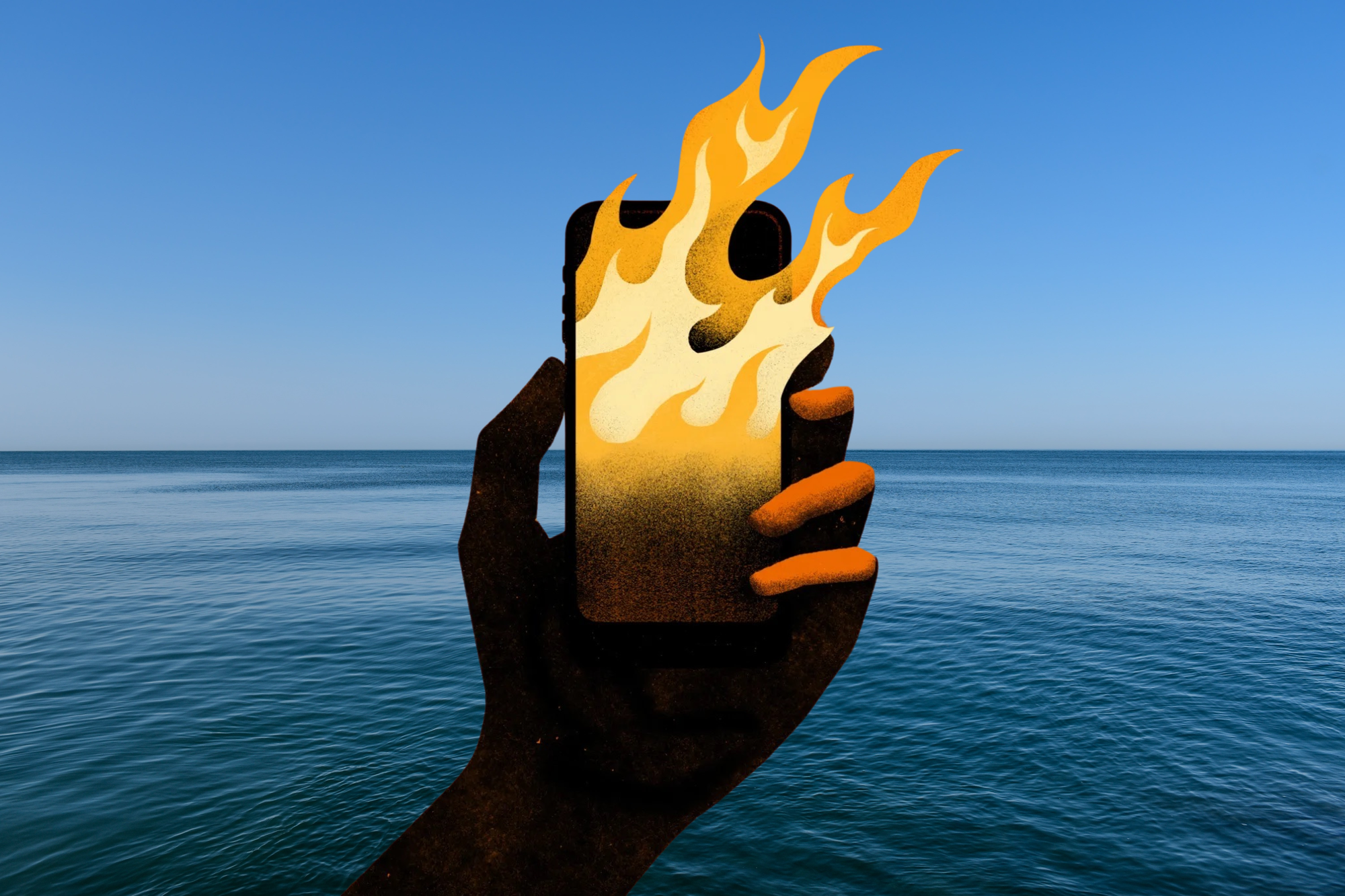
A war with Iran in its fourth week—a nuclear plant struck, the Strait of Hormuz closed, oil up nearly 60%. Arctic sea ice at a record low, global warming accelerating, the planet on course to breach 1.5°C before 2030. Cuba going dark under a US oil blockade, half the island without power, hospitals failing. The FCC threatening broadcast licenses over coverage it doesn’t like. All of this before coffee, all of it already in your palm.
Cue the anxiety and dread.
That’s what’s “out there.” But what’s happening inside? Beneath the doomscrolling is a compulsive search for certainty, forever elusive. This dynamic is far older than smartphones; it’s part of our evolutionary heritage. The mind wants to solve, to land somewhere stable, to know how it all turns out. Presented with matters genuinely unresolvable—a war with no clear endpoint, an expanding climate crisis, weakened social safeguards—it doesn’t stop looking. It keeps reaching. More information may feel like progress toward resolution. It isn’t. But the compulsion has its own logic, and The Algorithm™ is very good at feeding it.
This is what attention feels like right now: minds so saturated with crisis, real or imagined, that it becomes a second skin—something we’re no longer wearing so much as inhabiting. Our nervous systems have evolved to respond to acute threat and then recover, not to run the same emergency indefinitely. Over time this produces a kind of learned helplessness: when action repeatedly fails to change outcome, the felt sense of agency quietly erodes, bleeding into domains that have nothing to do with the original stressor. Yet mind still seeks to confirm, to justify, to resolve—mistaking the scroll for solid ground.
None of this is your fault. And a bunch of it is by design.
Here’s what the attention economy critique gets right: the machine is designed to hold you there. Outrage and dread are stickier than contentment; The Algorithm™ is finely tuned to deliver just that. Knowing this doesn’t help much. You can understand the mechanism completely and still find your thumb moving. Because what the critique misses is less flattering: the restlessness was already there.
The feed didn’t create the reaching; it built a 24-7 casino for it. Restlessness craves distraction and calls it relaxation. Half-watching something, one eye on the phone, refreshing not because you expect good news but because stopping feels like falling behind. This is the pattern; not real rest but the performance of rest while we keep scanning, running the numbers on a reality that has no resolution and is beyond our control.
When we are activated along these lines, what brings relief seems counterintuitive. Not more information, not forced suppression, but taking a pause; noticing things beyond the noise. Nourishing food, cutting the news at a specific hour and actually doing so, getting outside long enough for the nervous system to remember it has a body that isn’t made of screens, setting down goals and agendas, even for a little while. Slowing down can help us rediscover what the Tibetan contemplative traditions call sem pa chen po—spacious mind. This is also part of our human heritage.
Spacious mind isn’t so much a technique as an orientation: familiarizing oneself with one’s own tender, non-judgmental awareness, vast enough to hold what’s there without being destabilized by it. This kind of knowing is neither fabricated transcendence nor escapism, and it doesn’t require believing things will be fine. It requires the harder thing, which is remaining in contact with what’s actually here while recognizing how everything is passing. Right now, the situation is what it is. Later, it will be something else.
Yet there’s a difference between intellectually knowing that and experiencing it directly and openly. To know oneself as the sky, not the weather—and from that ground, act accordingly. Not from urgency or overwhelm, but from something steadier: the part of you that was never actually swept away.