Alienation Engines
Why the focus on economic displacement misses the deeper crisis of meaning in work.

Microsoft CEO Satya Nadella recently made a statement about how the AI business model encourages what he calls information asymmetry—you hand over your hard-earned proprietary knowledge to the AI provider, the provider soaks up the value, and you don’t get much back beyond tight code and iffy editorial.
Nadella’s fix for this “reverse information paradox” boils down to sharing your data while somehow retaining your knowledge. Maybe it’s just a bunch of bullshit to get more people signed up for Copilot. His claim that “by consuming intelligence, you are creating intelligence, and what you create should belong to you” could win this year’s Technobabble Award, sponsored by WeWork.
Around the same time, nearly 200 economists and technologists—including 15 Nobel laureates, Anthropic co-founder Jack Clark, OpenAI CFO Sarah Friar, and former Commerce Secretary Gina Raimondo—signed a statement called “We Must Act Now,” warning that AI could drive a labor transformation larger than the Industrial Revolution across a much shorter period.
These eggheads call on policymakers to establish incentives and guardrails that steer the technology toward complementing human beings rather than displacing them. Otherwise, they say, we get economic destabilization before AI delivers whatever alleged gains are being hyped this week—which, as I’ve written before, tend to stay concentrated at the top.
The whole thing has a certain stop-me-before-I-kill-again vibe. Not to mention that today’s policymakers seem even less up to the task of regulating a massively disruptive technology than their dawn-of-the-internet predecessors. Actually, some are the same people.
Both statements look through the lens of employment, though Nadella talks about intellectual property, which is rich, given that AI is already built on pilfered cognitive output, much of it under copyright. But there’s more here than jobs and IP—something that’s been discussed for twenty-five centuries under a different heading: right livelihood.
Right livelihood—samma ajiva—is part of the Eightfold Path in Buddhism. People sometimes reduce it to a list of forbidden occupations: don’t be an arms dealer, a human trafficker, don’t sell drugs. Useful guidance, but it goes deeper than career counseling. What you do all day is who you’re becoming; the job works you, too. In capitalist terms, labor is a transaction converting hours into wages. But at its best, it impresses attention, skill, and care into the laborer as well as the product or service.
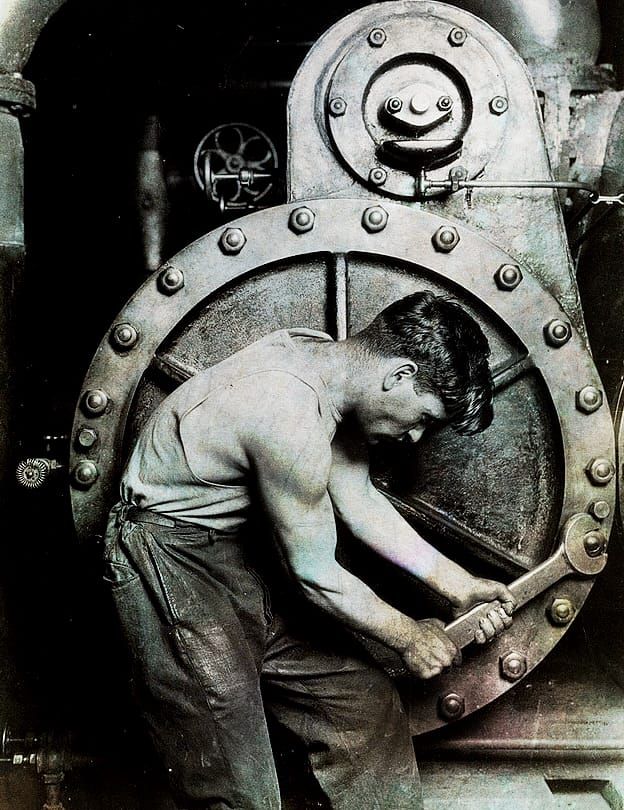
So “job displacement” doesn’t quite cover it. The job is merely the container; the livelihood is what fills it. And much of the expertise AI is displacing isn’t in the data—it’s in the wisdom of experience. A machinist’s sensitivity for calibration. A nurse’s deeper read on a patient. An editor’s eye to shaping a sentence. Some, but hardly all, of that expertise can be extracted, standardized, and sold back as a product you rent. But it never touches the relationship between a person and their vocation—the living current of how they relate to their labors, themselves, and the world.
That commie Marx had a word for when this connection is absent: alienation. It wasn’t just that workers were underpaid, though they surely were (and are). Industrialization estranged people from what they made and consumed, severing an important link between effort and meaning. Whether or not you go the full Trotsky, perhaps it’s time for right livelihood to graduate from under-recognized principle to active movement. I’m not ignorant of the complexities here. But so much starts with intention.
So sure, the economists are probably right that the window is short and getting shorter. But whatever is established from here—transition aid, harm mitigation, Butlerian jihad—should aim at more than employment statistics. The finer measure is participation in the value of our labor and the meaning of our days, to say nothing of a self we can live with, and that others can live with, too.