Bad Directions
For a generation that inherited an unreliable map of reality, horror lives in the spaces between certainty.

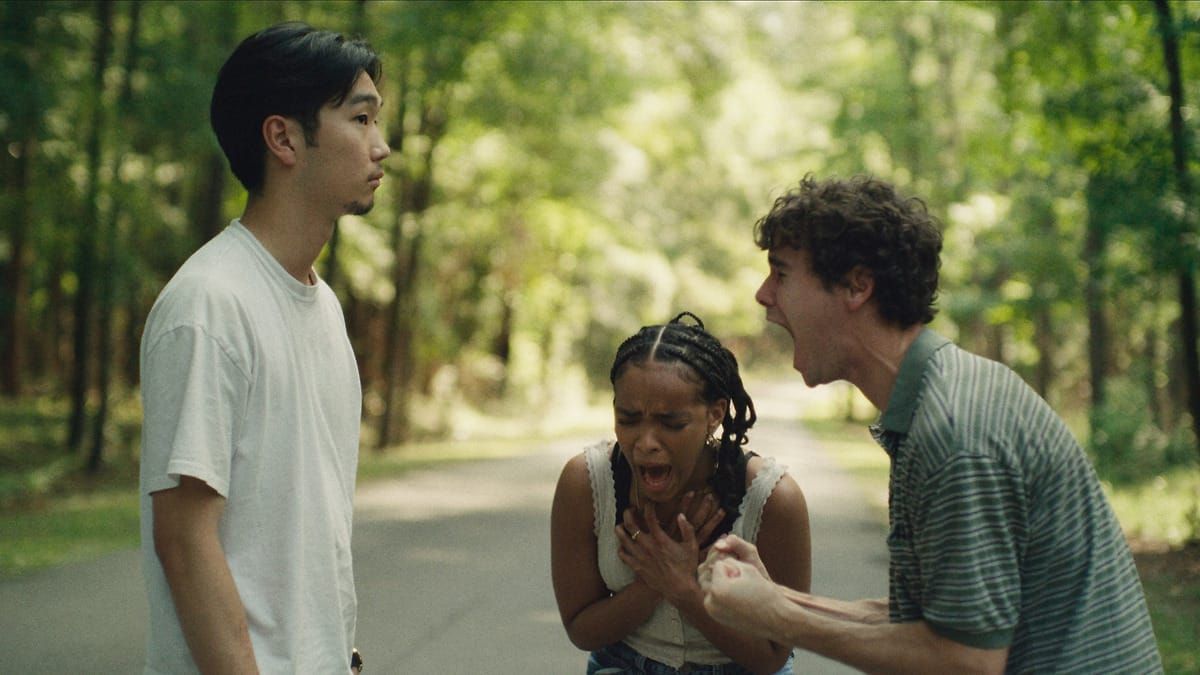
Last night I took a look at a newish film called It Ends, which technically came out in 2025, premiering at South by Southwest in March. It briefly appeared for rental through Letterboxd in December, where I somehow missed it, and opens theatrically today via Neon.
You could put It Ends in the same general category as Backrooms and Obsession: inexpensive psychological horror made by very young filmmakers who seem to have arrived at a shared visual and narrative vocabulary. I’d describe it as broadly liminal. Settings, situations, relationships and cinematography all convey a sense of in-betweenness or unsettledness. Things either don’t resolve or resolve in ways that leave reality anything but dependable. (Kind of like actual reality.)
There’s a Buddhist word for this territory: bardo. I won’t lean too hard on the comparison, but bardos are intermediate states in which the ordinary coordinates of experience have broken down and whatever comes next hasn’t stabilized. Expectations about how things are supposed to be no longer hold.
That seems close to the heart of this emerging strain of Zoomer horror. Part of the tension may come from growing up aware of the calamitous times we live in. There’s really no hiding this stuff from kids once they reach a certain age. As a Gen X parent with a teenager and a nine-year-old, I find that terrifying enough. Whatever uncertainty I feel about the future, I at least grew up expecting that a reasonably stable society would be waiting for me. Younger people didn’t necessarily even get that.
It Ends, written, directed and edited by 27-year-old Alexander Ullom, makes that unease literal and perpetual. Four recent college graduates take a wrong turn and discover that the road they’re traveling simply does not end.
There is no explanation. The car doesn’t run out of gas, even when the gauge sits near empty for what may eventually amount to years. Every time they stop, they have roughly 90 seconds before people come screaming out of the woods, begging to be let inside. If they catch you, they’ll tear you apart. Otherwise, these same folks lie semi-conscious among the trees, offering no useful information about what’s happening.
Some reviewers have compared the setup to Jean-Paul Sartre’s No Exit, which makes sense. Sartre’s characters are trapped together in an afterlife whose torment produces the famous line “Hell is other people.” It Ends is less concerned with philosophical argument than something more basic and contemporary: inhabiting a reality whose rules you cannot determine. It could practically be called Anxiety: The Movie.
I had no problem with its refusal to explain itself. Yet It Ends may be a special kind of torture for viewers accustomed to movies and television that underline every theme, motivation and plot development. Coming from a generation raised on irony, ambiguity and absurdist distance from whatever was being portrayed, I find all that explanation exhausting. It’s OK to let some things remain inexplicable.
Watching four people sit in a Jeep with essentially nothing to do but drive is surprisingly engaging. The opening is a little clumsy, but eventually the natural rhythms of young friends on a road trip emerge. They joke, irritate each other, reminisce, panic and argue even after the ordinary world has disappeared.
The ensemble is good, although I didn’t find the performances quite as sharply established as those in Obsession. That film’s director, Curry Barker, spent years making comedy and horror with Cooper Tomlinson on their YouTube channel That’s a Bad Idea, and you can see the results in how efficiently Obsession establishes relationships before distorting them. Barker knows how the same interpersonal dynamic can become funny or deeply unnerving depending on how you turn the dial.
Still, Ullom does an impressive amount with very little. The cinematography finds inventive ways of making a Jeep, a road and some woods visually interesting. Certain compositions become metaphors for the characters’ predicament: forward movement without progress, enormous space that nevertheless feels claustrophobic, a horizon promising elsewhere but never delivering.
There’s something of The Twilight Zone here, too, but not in the self-conscious way that so many attempts to revive Rod Serling’s formula have gone about it. It Ends simply presents an impossible situation, establishes a few arbitrary rules and compels relatable human beings to exist within them.
Maybe that’s why this aesthetic feels particularly suited to the moment. The horror is discovering that the world does not operate according to the playbook you were given, that nobody can explain what’s going on, and that nevertheless you have to keep moving. For a generation coming of age amid climate instability, political dysfunction, pandemic, economic precarity and technological upheaval, perhaps the endless road doesn’t require much explanation.
If you enjoy—or are simply curious about—liminal Zoomer horror, It Ends is well worth the drive.