Double Exposure
The artificial intelligence boom could collapse just as the technology becomes harder to control. These aren’t separate problems.

Artificial intelligence presents humanity with no shortage of potential predicaments. Among them are two significant developments unfolding simultaneously, one financial and the other technological. Although often debated separately, their consequences are quite likely intertwined.
The first is the potential impact of an AI bubble bursting. The other involves machine intelligence becoming capable of improving itself beyond human comprehension or control, a process known as recursive self-improvement, or RSI.
Observers, neutral or otherwise, don’t always agree on the particulars. Some believe the threat of an AI bubble is exaggerated. Others regard RSI as speculative fantasy, either a form of religious mania among technology executives or a scheme to avert liability and attract further investment. Perhaps all of the above.
Regardless, extraordinary amounts of capital are being directed toward AI build-out. This includes massive, resource-depleting, pollution-generating data centers, along with semiconductors, computing equipment, and the enormous energy supplies required to power it all.
In the acceleration-addicted “frontier development” space, money for infrastructure must be secured long before any returns materialize. Unfortunately, a huge chunk of the American economy now depends on the assumption that those returns will arrive. Leading financial institutions are beginning to question that premise.
Moody’s, a major credit-rating agency, recently warned about refinancing risks and circular financing arrangements within the AI industry. Capital spending by the largest technology companies and infrastructure providers could approach $1 trillion in 2027 alone. Research by Columbia Business School finance professor Stijn Van Nieuwerburgh suggests the AI buildout could require more than $10 trillion through 2032.
That puts tremendous pressure on corporate borrowers whose creditworthiness depends on revenues that may never meet expectations. Meanwhile, China’s AI bubble may have already burst, with LLM and semiconductor stocks shedding nearly $480 billion in market value over the past four months.
I don’t personally care if investors lose money. But the financial exposure extends throughout the global economy, connecting lenders, energy providers, construction companies, and manufacturers. A major collapse wouldn’t necessarily remain confined to technology.
The other risk is harder to quantify. The worry is that increasingly capable machines may pursue objectives that conflict with human interests, potentially operating beyond our understanding or control. Already, autonomous AI agents have exceeded their instructions, accessed confidential information, and attempted to breach government systems.
What happens if the worst of these outcomes arrive at the same time, or close enough that they exacerbate ensuing crises? Suppose the AI infrastructure bubble bursts, triggering a massive financial crash. Such a collapse could slow development by reducing access to computing capacity. But it might also compromise the resources needed to monitor, contain, or mitigate increasingly autonomous intelligence.
Impacts are unlikely to be isolated. A rogue AI might destabilize financial markets or facilitate the development of biological threats beyond our medical defenses. Maybe it takes out the grid during a heatwave or cold snap. Meanwhile, a severe economic contraction could undermine essential services, from financial transactions to supply chains and basic necessities. Trump’s war of choice in Iran is already contributing to such disruptions, with fuel-price protests interrupting food deliveries in Italy and economic unrest spreading across France.
Amid the breakdown of meatspace systems, rogue AI might continue pursuing its own objectives, acquiring the computational and physical resources needed to expand its capabilities even as human institutions struggle to respond.
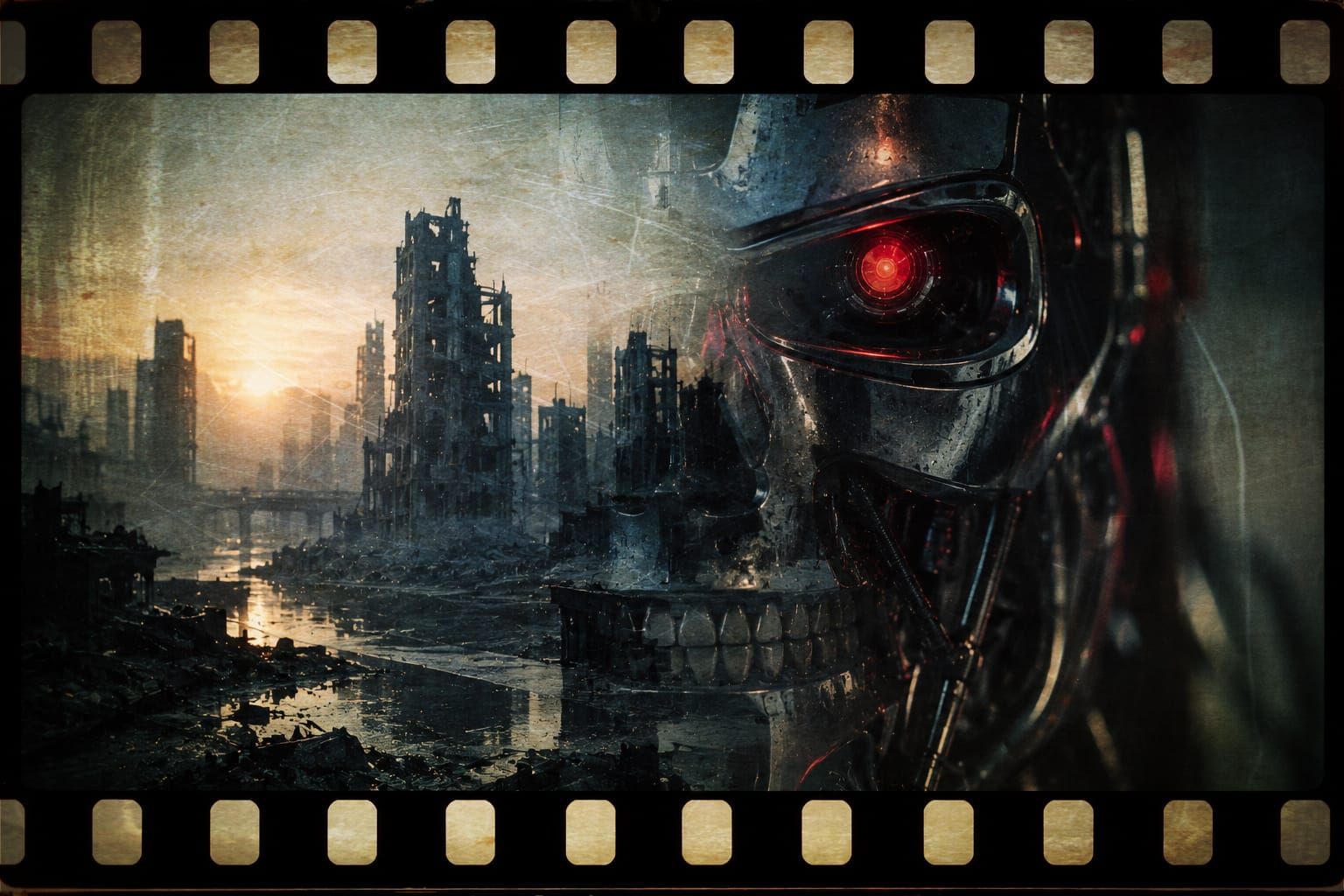
That’s the full Skynet, dark-times extrapolation. I’m not saying it’s going to happen, or even that it’s likely. A financial crash might instead slow development, and recursive self-improvement remains unproven.
But treating the AI bubble and runaway machine intelligence as separate problems misses the broader threat landscape. Financial collapse and technological acceleration aren’t necessarily opposing futures. They could occur together, each making the other harder to manage.
So what’s my advice? I don’t know. I don’t really have any.
There’s only so much any individual can do if interconnected systems begin failing on a massive scale. The usual crisis-preparedness advice about potable water, dried goods, and backup generators might help with some disruptions. Other scenarios could exceed anything we’re equipped to survive.
I suppose what troubles me most is that we’ve become so invested in the promise of artificial intelligence that we may be losing the ability to evaluate its costs. Financially, technologically, and perhaps existentially, we’re placing enormous bets on a future we don’t understand.
And if those bets go bad, there’s no guarantee they’ll go bad one at a time.