Outrunning the Echo
The hardest part of evolution isn’t finding the formula—it’s letting go of the one that’s working.

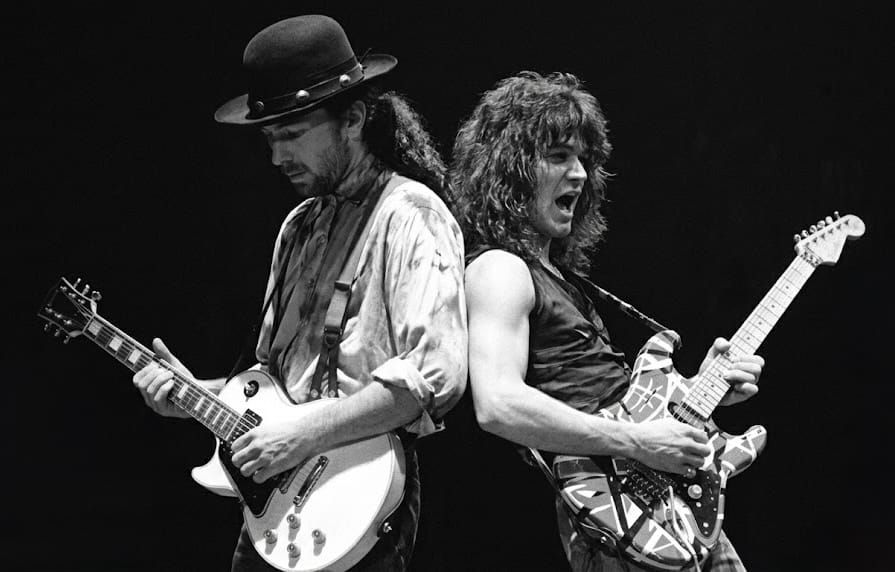
Transformation comes in many guises. The following account, though super boomer, fairly rocks.
Picture in your mind’s eye: Edge from U2, circa 1988, in a stadium packed to the gills with screaming fans. He stands in the center of a sonic rose window, chiming guitar patterns refracting and shimmering through delay and reverberation across the cavernous venue and back again.
At some point he realizes he’ll be stepping on those same echo boxes for the rest of his life. An endless series of dotted eighth notes, chime, chime, chimey chime. What was once an invitation into wider sonic terrain is now an uncomfortable constraint. Especially being not only successful within a genre, but actively defining what that genre means to everyone else. And figuring out how to play the guitar along the way.
That was U2 in the 80s. Their sound gave shape to the contemporary musical landscape, helping establish how rock music was understood at the time. One imagines that could start to chafe.
Edge’s bandmate Bono is pretty clearly in the lineage of artist-as-change-agent. His predecessor-slash-contemporary David Bowie was a technicolor permission slip, but there are plenty of examples in jazz and even modern conservatory music—from Miles Davis to Igor Stravinsky—where a creative force doesn’t just inhabit culture but willfully refashions it.
That level of accomplishment, of course, breeds imitators. Lots of them. Enough that decades later you can still hear artists working through various versions of the same formulas (hello, Coldplay!). Yet success isn’t always aligned with stability, and sometimes the opportunity for transformation arises because things fall apart.
Take Van Halen. David Lee Roth exited the band in 1985, and that rupture became an invitation to evolution. Eddie Van Halen used the split to completely shift direction, adding (more) synthesizers, composing in different registers, and generally enhancing the aural presentation. Obviously, a new singer with a broader range was part of it, but by dismissing longtime producer Ted Templeman, Eddie jettisoned a production style that had served as the band’s recorded identity, widely imitated across hard rock in that era.
I personally prefer the original formula, but I can also appreciate what it must have taken to step away from that template—especially in the midst of commercial expectations, label insistence, and audiences who were absolutely expecting more of the same. Relationships aside, nothing was actually broken with Van Halen; measured by output quality and commercial reception, things were going swimmingly.
The urge to initiate change often comes from ambition or other expressions of ego; surely a factor in the above examples. But I don’t think self-transformation necessarily requires self-attachment. The intuition that embraces change can come from a simpler recognition—that everything is already in motion, already being transformed whether we intervene or not.
From there, the approach becomes less about forcing change and more about softening how tightly we’re holding the current configuration. Not because stability is wrong, but because it’s never permanent. This is not the case somewhere later, but right now. That can be an invitation to get creative, whether the chips are up or down.
Then the question becomes whether we’re able to dance with transformation as an inseparable part of it, or whether resistance prevents the recognition of an opportunity for evolution. Growth often means giving something up, and opportunity is never a guarantee. Still, the realm of possibility is a pretty cool place to live, even temporarily.