The Adjustment Bureau
We spend our lives fiddling with the thermostat of experience. What if we left it alone?

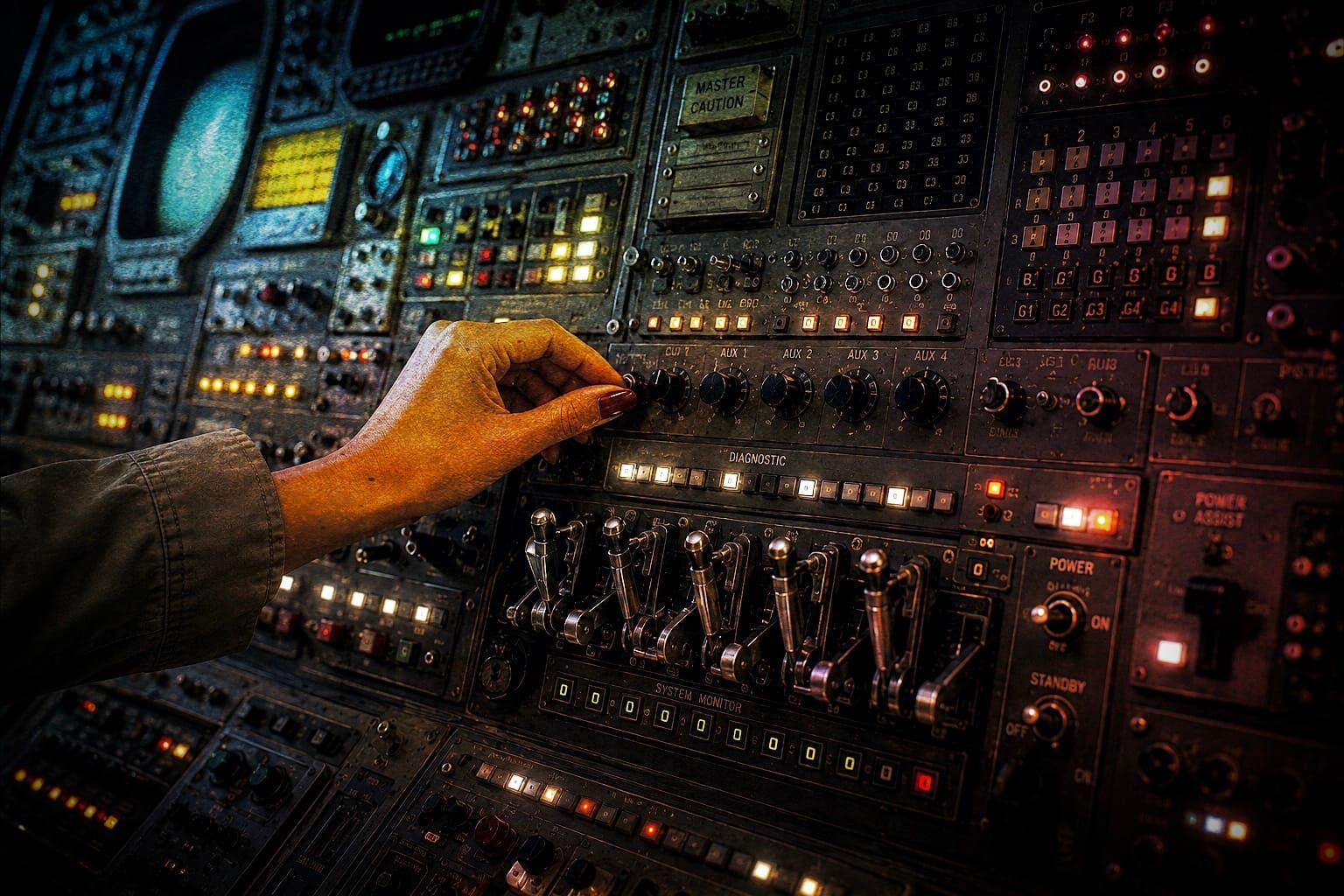
Human beings devote an unaccountably large portion of time to making adjustments, big or small. Such activity encompasses most aspects of our everyday existence—tweaking the playlist, rewriting emails in different tones, gaming out difficult conversations, and retroactively applying narratives to maintain a sense of continuity within ourselves that maps to internalized identities.
All of these actions are in some way driven by the illusion of control: a belief that through our own efforts, we can bring our lives into alignment with our desires. The “human condition,” as it were, is an ongoing and overarching attempt to conform life to our preferences. It isn’t that our actions are inherently bad or wrong, it’s that we typically don’t recognize how the individual taking action—in this case, us—is fundamentally inseparable from that which is being acted upon.
The external world we perceive is plenty real. I’ve stepped in enough cat puke to confirm. When it happens, there’s a self who says “gross!” Yet on both the level of individual experience and objective analysis, every aspect of what we call “I” is mutually shaped—from elementary particles to choice in wardrobe. Nothing comes from nowhere; all phenomena are preceded by prior causes that manifested along these same lines. There’s no way to get the peanut butter out of the chocolate. Everything arrives premixed.
On a biological level, survival often necessitates action. But as is the case with many things, humans take it to extremes. Our existential condition inspires anxiousness, restlessness. More frustratingly, there’s a sense that we had no hand in choosing any of it. This view is in some ways closer to the reality, though still incomplete.
No one picks their temperament from a catalog. No one consciously assembles the associations that make one space feel cozy and another destabilizing. At the point a preference announces itself, the mechanisms that engendered it have already fired, to the extent that what we call decision-making is more an expression of “inner” conditioning meeting “external” stimuli.
Humans aren’t all that complicated. We seek three primary things: certainty, comfort, and novelty. These aren’t always in alignment within ourselves, to say nothing of the external world. Even when things do click into place, it’s not forever.
Our difficulties are further compounded by the dividing of experiences into pre-assigned categories that engender our own dissatisfaction. Here are three big ones: Kill It with Fire; Acquire and Defend; and the largest bucket: Didn’t Even Notice. Think about your average day. How much mental, emotional, and energetic time is spent in these precincts?
If we can’t control the inner weather, how can we expect to control the external? The real answer is we cannot. Ultimately, everything we attempt to influence is merely a temporary manifestation of causes far beyond our ability to contain or comprehend at the individual level—the global economy, the environment, the internality of others, etc. We are not the manager of any of these processes. We are, however, co-participants.
Abandoning control doesn’t mean what we do won’t make a difference. In fact, every action we take has an impact; just not in the one-to-one way we typically envision. The Buddhist idea of dependent origination—also known as interdependence, and my favorite, interbeing—captures this idea well enough.
Much of this comes down to mindset. As long as I continue to believe I should be in control, my focus remains on the discrepancy between how things are and how I want them to be. When these fail to line up, I experience my own suffering.
Conversely, when I relax expectations arising from the need to control, what remains might be called discernment; part of a spectrum of self-arising wisdom available when we get out of our own way. Then, action is free to arise from attunement, rather than fiat.
It’s good to recall that transformation is not waiting for our approval, whether we consciously act or not. It’s happening right now—in every cell of our bodies, in each moment we apply a label to what we observe or experience, inside or out. Zap! It’s all completely changed. Zap! There it goes once more. But to where? That could be worth contemplating.
Acceptance is not the end of agency; it is its beginning. What is relinquished is not the power to take action but the fantasy of doing so independently. The clarity that emerges allows even the smallest gesture to flow unimpeded. Not that there’s a scoreboard, but this can have a potentially greater impact than imperious agendas borne of ignorance. When we stop trying to dictate outcomes, we finally become free to participate in the unfolding. What a thing!