When is a Band a Cult?
Having written a book about the Grateful Dead—and cult dynamics in music more broadly—I’ve been thinking seriously about what “cult following” actually means. Spoiler: it’s less pathology than anthropology.

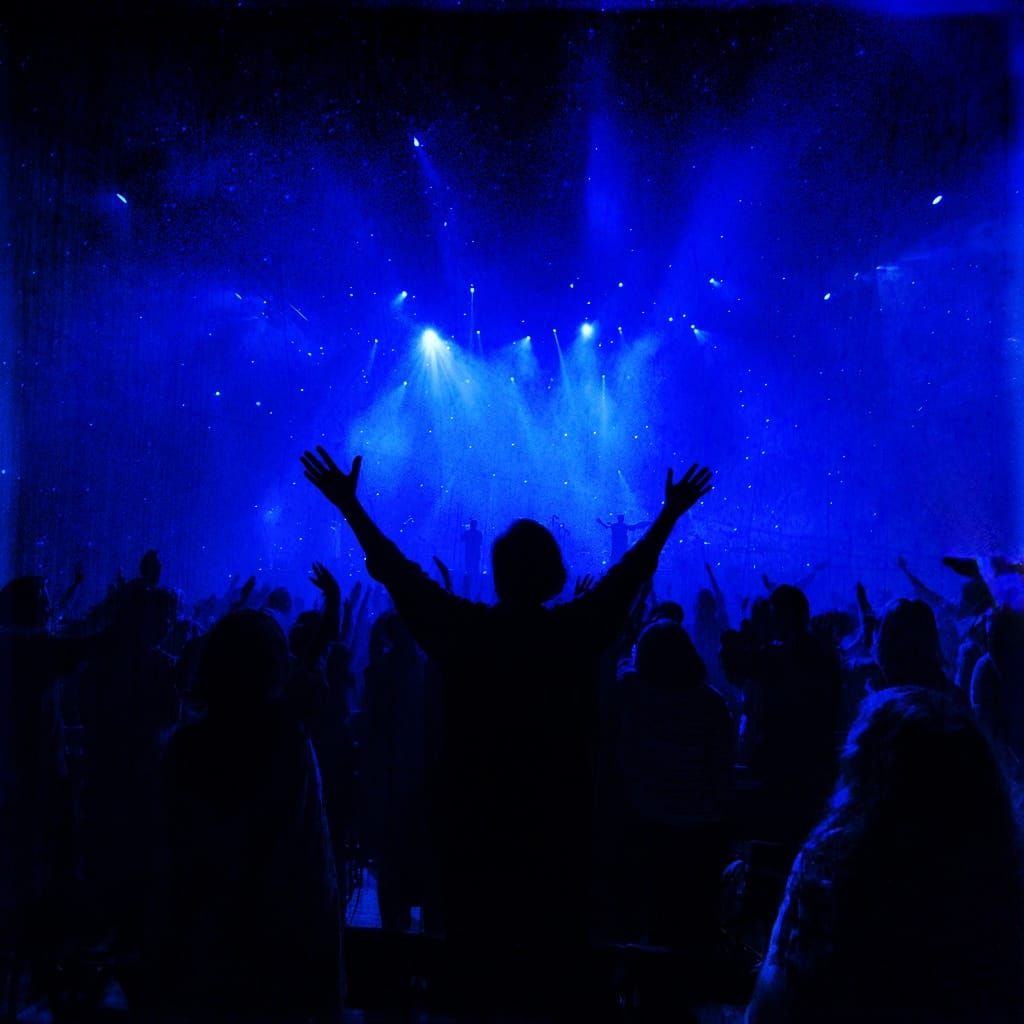
We’ve all heard the term “cult following”—critical shorthand applied to just about every form of media—but lately I’ve been thinking about what it means specifically for music. Having written a big ol’ book about one such phenomenon, the Grateful Dead, I feel like I can speak with some credibility here.
Cult dynamics in music fandom look a lot like cult dynamics anywhere else. There’s always an object of reverence, insider signifiers, and some degree of identity fusion—what Lucien Lévy-Bruhl called participation mystique, a pre-rational merging with something beyond the self. Carl Jung later recognized it as a persistent feature of collective experience rather than a relic of primitive consciousness. With music, you have the additional possibility of shows functioning as ritual, which is part of what I explore in my new book Dead Dharma: The Grateful Dead and the American Quest for Transcendence.
The Dead are a good case study, because they present as a multiverse—layers of sound and symbol, as dense as they are unwieldy. Their output spans decades and eras, and both the studio recordings and voluminous live archive vary wildly in quality, however one might conceive it. All of the above makes the Dead tough for outsiders to penetrate, and often the music itself does no favors.
With cult music there’s typically an initiatory barrier inseparable from the work. I’ve run into this when people ask me how to get into Blue Öyster Cult, whose name is truth in advertising. You may never find an entry point. Or you might plow through and come out the other side with glowing eyes and an expanded vinyl collection.
The Dead were the modern traveling mystery school, but there are as many variants of cult act as there are genres. Phish are heirs to some of the Dead’s strange magnetism, but this isn’t just a hippie jam phenomenon. To wit: Robert Fripp is essentially the Gurdjieff of rock, and King Crimson functions as an object of cult veneration with all the attending rigor. Frank Zappa’s devotees are easily as persnickety—and some would say insufferable. Springsteen obsessives are born to run the setlist by you whether you asked or not. Queen appreciators are fastidious and precise. You catch my drift.
Some artists have attempted to deliberately engineer culthood. Psychic TV, the brainchild of industrial pioneer Genesis P-Orridge, whom I wrote about in William S. Burroughs and the Cult of Rock ‘n’ Roll, actually built an initiatory apparatus around the music. Sun Ra conceived a multi-world spiritual system as an avatar of space. Devo arrived with a complete ideology—the De-Evolution theory, which is now just the news. Robert Pollard and Guided by Voices created a hermetic codex out of decades of accumulated indie-garage-pop-prog-rock. And Nick Cave appears to be entering his final seminary form, with a transcontinental congregation in tow.
The above examples came along in the twentieth century. Though only a few are still active (or alive), all remain revered within their cloisters. Post-millennial fandoms can be even more massive in scale and reach, yet simultaneously more insular and less forgiving. (Cheers, Tay-Tay.)
Culthood is often outside an artist’s control. Jerry Garcia absolutely did not want to be deified, and did everything he could to avoid it; in part because he saw it as a slippery slope for both himself and the audience. The line between community and cult is hard to locate from inside the experience. In Dead Dharma I take that seriously, examining the ways charismatic imbalances of power operate inside both musical and spiritual worlds and the considerable excuse-making that surrounds them.
So when is a band a cult? Maybe the better question is when isn’t it. That hunger that turns a fanbase into something more than a passive audience—the need for meaning and initiation—is less pathology than anthropology. We’ve always done this. The names change, the signifiers evolve, the mystery school moves to a different village, but the impulse to gather around something powerful and to let it remake you is about as old as fire. The question is what you’re actually getting out of it—an expensive t-shirt and a trip to the Sphere, or something closer to sacred.